How Claude’s Watermark Works and What It Means for Marketers

Anthropic recently announced a new watermarking system designed to detect whether text was generated by Claude. The move is already polarizing, with some applauding it and others canceling their Claude subscriptions in protest.
In this issue of The Grip, I’m going to explain how Anthropic’s watermark works, the case for and against it, and what it means for marketers moving forward. Let’s get into it!

How Claude's Text Watermark Works
Since its debut in 2023, Claude has been used to write everything from LinkedIn posts to court filings. While there were always obvious tells for AI-generated content, like “it’s not x, it’s y,” or the overuse of words like “quietly” and “reshape,” tracing a piece of writing back to a specific chatbot hasn’t always been easy. But it wasn’t unheard of.
That same year, Google DeepMind introduced SynthID, a watermarking system which helps people identify images created by Google’s AI. And in 2024, Google expanded that system to include text as well.
Now, Anthropic is putting its own spin on that same technique to watermark text created with Claude. Here’s how it works…
Claude writes text one word at a time. Because Claude doesn’t actually know any words, it converts them into numbers. As it writes, it predicts the next word based on everything that came before it. When there's a spot where multiple words with the same meaning could be used, Claude uses a weighted spin of the wheel to decide which word to choose.
For example, let’s pretend I’m using Claude to write about how cold my igloo is. The sentence might start: “Man, my igloo sure is…” Claude then makes a weighted selection between cold, freezing, frigid, or even nipply.
Pretty straightforward, right?
This is important because Claude’s watermark isn’t some piece of metadata burned into the text. The watermark actually lives in the words Claude chooses. It uses a key, which is just a rule that nudges Claude toward choosing one word over another when they have roughly the same meaning.
That key, or rule, is essentially a math formula, and the words are literally the numbers, like we said earlier. So, going back to my example, the key might push Claude to choose “freezing” instead of cold, frigid, or nipply. This pattern of chosen words made according to the key’s formula is the watermark. Think of the watermark like a bloody fingerprint at a crime scene. The fingerprint is the watermark and the finger that left it is the key.
This watermarking process is being applied to all of Claude’s products and anywhere Claude can directly input text, like Slack and Gmail. Does that mean your boss can tell when you phoned in an email with Claude? Not quite, it can only be identified by Anthropic and any platforms that connect to its watermark detector API, which hasn’t gone live yet. So, if you find any Claude watermark detectors floating around Google, just know that they’re 100% bullshit.
As of August 2026, this watermark is still rolling out globally. Any Claude models launched from here out will contain watermarks, with older models getting the feature soon. The watermarking is specific to text, since code is an entirely different beast. As for images, Anthropic already uses C2PA which embeds metadata in the file indicating that it was AI-generated.
What Claude's Watermark Means for Marketers
So, why did Anthropic do this? It wasn’t done to be ethical or promote transparency in the age of misinformation, that would be too considerate. The answer’s simple, they did it to comply with the EU’s AI Act which requires AI companies to label AI-generated content in a way that is detectable. Anthropic clearly anticipates regulation from other parts of the world, so they made this a global move proactively.
Some people are pissed at Anthropic for two reasons. First, they rely heavily on Claude for writing and editing, so the watermark feels like it exposes them, which, to be fair, it does. Second, they believe Anthropic trains its models on stolen IP, making the watermark feel like Anthropic is claiming ownership over content that isn’t theirs. Both camps may be happy to learn that the watermark can be removed by heavily rewriting Claude’s output. Light edits won’t cut it.
But at that point, you’re putting so much time and effort into not writing something that you should probably ditch the AI or find a profession that requires less writing altogether. While I don’t think there’s anything wrong with using AI as a thesaurus, spell-checker, or even a tool to help tighten your copy, the watermark can push you to improve your writing and think harder, two things will never steer you wrong.
I don’t need to beat a dead horse here, but we’ve seen countless studies showing that people dislike AI-generated content. The general consensus is that it can feel lazy and cheap. Whether you agree or not, it’s a real problem, and platforms are increasingly making it easier to identify and limit low-effort AI content. If you think every major social media and email platform won’t eventually plug into detection APIs, you’re in for a big surprise. And not the fun, clown-popping-out-of-your-birthday-cake kind. Okay, maybe I’m alone on that one...
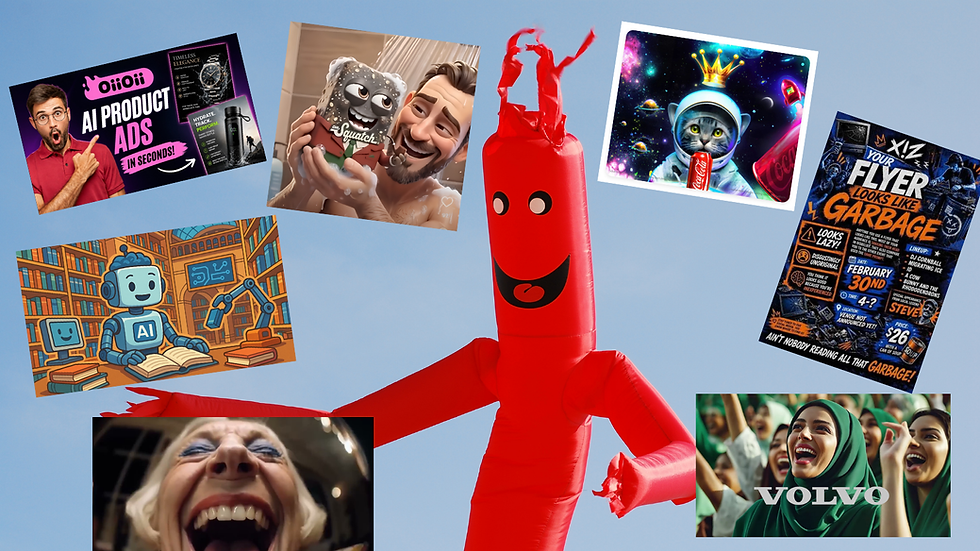
To me, AI-generated content is the floor. It's the new wacky waving inflatable arm-flailing tube man you see in front of every car dealership. It’s cheap and gimmicky. If you have the resources to produce something authentic that stands out and engages humans on an intimate level, that’s your edge and you should play into it. Because watermark or no watermark, your audience will sniff out AI-generated content, except now it’ll get broadcasted to everyone.

Why Claude’s Watermark Is a Transparency Opportunity for Marketers
One way teams can get ahead of this, is to publish a transparent AI policy. You should proactively tell your audience how and where you use AI in your work to set the record straight. Clay’s COO and Co-Founder, Varun Anand, publicized his company’s AI writing policy days before Anthropic announced its watermarking system. In it, Varun holds his entire company accountable for every line of text they create, AI-generated or not.
Not only will your audience appreciate this sort of transparency and accountability, but they’ll respect you more for it too.
As for those who choose to fully lean on AI-generated content in their marketing, if you feel confident in that decision, you should have no issue standing by it.
Regardless of which side of the fence you’re on, I think we can all agree that trust is everything in marketing, and if you want your customers to trust you, the least you can do is be honest with them.

