AEO, GEO, and AI Search Snake Oil

Updated: Jul 15
Of all the areas of marketing disrupted by AI, SEO has been hit hardest. AI has fundamentally changed how people research and discover brands, making SEO more important than ever.
But as is frequently the case with AI, two things are guaranteed: new ways to make money and new ways to bullshit people. The sweet spot is doing both at once.
So naturally, a cottage industry has emerged to cash in on the AI search hysteria, built around two inescapable new acronyms (because marketing can never have enough of those). I'm talking about AEO and GEO. Answer Engine Optimization and Generative Engine Optimization. And everyone from software companies to consultants is scrambling like eggs at a Waffle House to capitalize on them.
But how much of what they're pushing is real, and how much is snake oil? Getting that wrong can be costly and it can also damage your website and business.

The AI Search Playing Field
Before we get into AEO and GEO, let's break down the actual state of search. Because the people pushing these acronyms are counting on you not knowing it.
First of all, Google is still the GOAT. It owns 90% of the traditional search market and its closest competitor, Bing, owns 5%. The rest are like seagulls fighting for scraps, except they can’t fly… they’re just search engines.
When it comes to AI search, Google's no slouch there either. Google is running three major AI search plays at once: AI Overviews, which reaches about 2 billion people a month, and AI Mode, which reaches 1 billion. Both live inside Google Search itself. Then there’s Gemini, Google’s standalone chatbot, which reaches roughly 750 million users per month on its own.
Meanwhile, ChatGPT has 900 million weekly active users. Perplexity and Claude, don’t share official numbers, but third-party estimates place both well behind ChatGPT in scale.
Even being generous to the competition, Google still leads on AI reach and most of that reach is within the default search interface billions of people already use. That means all that activity is search-related specifically. The same can't be said for ChatGPT or Claude.
And now that Google's updating its search bar to be more AI-centric, that distribution advantage only grows. Meanwhile, ChatGPT's growth is plateauing, and OpenAI, Anthropic, and Perplexity are all on shaky financial ground. Any one of them could morph drastically or dissolve over time. Either way, Google isn't going anywhere, which makes them the most consequential player in search, AI or no AI.
But that doesn't mean marketers should ignore the other AI search players in the meantime. 43% of consumers now use AI tools daily, and 94% of B2B buyers use AI to research vendors as part of their purchase decisions.
However, the problem isn't choosing which AI search platform to optimize for. It's that AI search doesn't really send much traffic at all.
AI Overviews drag down click-through rates to top-ranking pages by 58% and 93% of Google's AI Mode searches don't result in a click. And Google’s new AI-powered search bar will likely make things worse. So, marketers should take AI search very seriously.
But how much of what appears in AI search results can marketers really influence or control? That’s where things start to get messy.
The Challenges with AI Search and AEO/GEO
Here's the thing about AI search. As much as it's growing, it's not reliable.
For starters, it's non-deterministic, which means it doesn’t always produce the same results. A SparkToro study found that the same prompt returns a different set of brand recommendations more than 99% of the time.
Even when you do show up in AI search results, the information shared has a high likelihood of being wrong. Nearly 40% of citations from AI tools are either wrong or completely made up. Even OpenAI itself admits that standard ChatGPT Search gets product information wrong nearly two-thirds of the time. Imagine asking ChatGPT if MailChimp includes custom forms and it wrongly tells you no. That might be a customer Mailchimp just lost without ever knowing they were in the running.
Lastly, even the people who built the LLMs powering AI search don't fully understand them. AI researchers at every major lab have been saying this for years. On Google's own podcast, Search Off the Record, engineer Nikola Todorovic put it bluntly, "these models function like, kind of like a black box. You don't always understand what's happening underneath." Yet somehow that old co-worker on LinkedIn who became “AI-native” overnight has it all figured out…
For better or worse, marketers need to accept there’ll always be a degree of mystery with AI search. Mystery is fine in gender reveals and murder podcasts. But when you're allocating significant spend to literally not be a mystery? Not ideal.
So, how do we solve these issues? We can't. They're inherent to the technology itself.
Yet, AEO and GEO are marketed as novel disciplines that help your brand “dominate” AI search. And both basically boil down to tactics that sound like thought-leadership buzzwords, designed to make basic concepts sound sophisticated, like "entity stuffing." Or "chunking." Are we optimizing for searches or adult film categories here? Seriously, "chunking" might be a cringier word than “agentic.”
Here's the irony. The promise of AI search is that it can process natural language and free us from rigid keyword optimization. Yet we keep being told we need to execute all kinds of technical tactics and dilute our writing into chunks to help the AI do its job. When in reality, we should just be giving it better content to get better outputs.
So, which is it? Either the AI isn't as smart as advertised, or these tactics don't actually matter.
In my opinion, the answer is the latter. So many of these new tactics that make up AEO and GEO are actually B.S.E.O. Google says so itself in its documentation.: "While terms like Answer Engine Optimization and Generative Engine Optimization are common online, many suggested 'hacks' aren't effective or supported by how Google Search actually works."
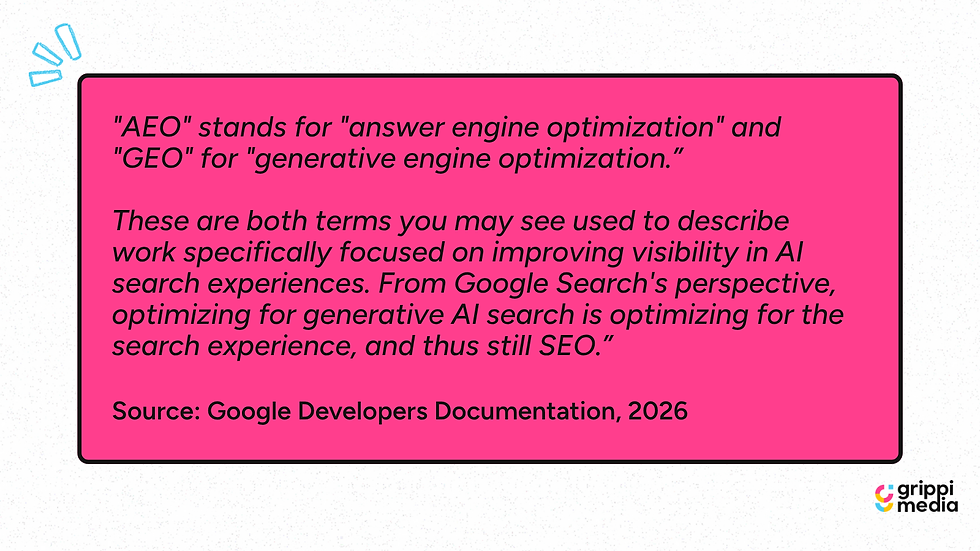
For years now, Google has been clear that nothing special is needed to show up in AI search results - just solid SEO fundamentals. EEAT. Quality content. Technical hygiene and so on.
Now, you might be thinking, "okay, but what about ChatGPT and other chatbots?"
Well, we already established Google's the most consequential player in AI search thanks to its distribution and scale. And traditional search is still in play, with Google handling 14 billion searches a day. ChatGPT handles 2.5 billion prompts per day, and most of those aren't even searches. I'm not going to alter my content against Google's best practices and risk my standing with them, just to maybe appear in AI chatbots whose futures are still fuzzy.
When you zoom out, AEO and GEO don’t really work as the standalone disciplines they’re made out to be. Look at Amazon or App stores. These platforms give you optimization levers that work in isolation, like listings, keywords, ratings, and categories. You can pull them without touching your website or anything else in your SEO stack.
AI search doesn't work that way. The only levers you can actually pull to influence AI search results are your website and off-page work, like digital PR, backlinks, and third-party reviews. You know, the very foundations of SEO. Mechanically, you cannot optimize for AI search without doing SEO.
And the measurement layer is really nebulous. Traditional search gives you keywords, search volume, ranking difficulty. Real numbers, direct from the search engines themselves. AI search doesn't have keywords. It runs on natural language prompts. And there's no official source or data for them anywhere. Some tools try to fill the gap through simulations and reverse-engineering Google's query fan-outs. It’s educated guessing, but it’s still guessing. And you’re paying for it.
So, between non-deterministic results, unreliable answers, speculative tactics, and spotty measurement, you'd expect AEO and GEO to be the cure. Instead, they're a symptom of the same mess and many of the tools and services built around them make things messier.
The AEO and GEO Gold Rush
Let's start with the tools.
AEO and GEO platforms run anywhere from a few hundred to several thousand dollars a month, and what you're mostly paying for is the ability to track prompts. These tools don’t have any official data from the AI search platforms. They just repeatedly send prompts to AI search platforms on a schedule and tell you how often you appeared. The more prompts you track, the more you pay. And because prompts are essentially speculative, it's easy to go from tracking a handful to raiding your kid's piggy bank to pay for your promptmaxxing addiction.

What’s worse is that no two tools give you the same data. So you're paying to speculate on the front end, and paying for speculation on the back end too. And with AI token subsidies dissolving by the day, these tools are about to get even more expensive.
That’s a lot to ask for something that's only directionally useful. And the toolmakers know this. Which is why many are repositioning as "all-in-one" marketing platforms that won't just track your prompts, but help you create and scale optimized content. Ironically, rapidly scaling content with AI violates Google's policies and can hurt your website long-term.
Here's the SEMrush data for a competitor of one of my health insurance clients. They went all-in on AI-generated content when ChatGPT debuted in 2022. Their rankings and traffic took off like a rocket. Then Google's spam systems caught up and it’s been downhill ever since.

Here are two major brands featured in the ads for one of the most well-funded AEO tools on the market. Leaders at both brands publicly endorsed the platform's AI content scaling features. But when you pull up their SEMRush data, it's the same story as the health insurance company. It worked. Until it didn't.
And if you look at the top example, you’ll see this brand’s AI Overview coverage appears to get significantly worse with time, whereas the brand in the bottom example never gained any traction in AI overviews at all.

But don’t take my word for it. Google's own guidance warns businesses to think critically about third-party tools, pointing out that none of them have access to Google's data, and are therefore providing speculative information.
The tools aren't the only ones stirring the pot. Many agencies and consultants, new and old, have begun offering AEO and GEO services. Some go as far as promising to get your site “ranking” in AI search, even though that’s impossible, since they’re non-deterministic.

Some agencies are vibe-coding their own proprietary AI search tools and upselling them to clients. Not only are they extracting an extra fee for a tool they built with zero technical expertise, they’re pushing the costs of running it onto the client. At best, these tools are clunky. At worst, they’re a security disaster.
Discoverability and Validation Over AI Visibility
No matter how much you invest in these tools and services, the measurement underneath all of it is still nebulous and the endgame they point you at is no clearer. We can’t measure vibes, so the industry defaulted to the next best thing: visibility.
Every tool, agency, and consultant will remind you that if your brand isn't visible in AI search, you're falling behind. Many of them even invent proprietary visibility scores for you to chase like a dog after its tail. Visibility is important, no doubt. But is it really the right target? Imagine your board asks for the ROI on your marketing spend and your answer is: “Good news - we’re visible!” I’d love to be a fly on that wall.

Just like with traditional search, websites can rank for keywords that aren't intentional or relevant. Sure, you're "visible." But how valuable is that?
Same with AI search. You could have high visibility from a strong web and media presence. But what if most of that buzz is bad? Or just plain wrong? Not all visibility is good visibility. Just ask the former CEO of Astronomer.
What you spend on these tools and services is your call. But you should aim for a better goal than simply being visible. Instead, you should aim for discoverability and validation.
Discoverability is appearing in searches that warrant action, like a click or eventual buying decision. Validation is the information that makes your audience confident enough to actually take it.
Here’s a no BS framework for building an AI search strategy that supports both:
Lead with SEO fundamentals: Practice solid on-page, off-page, and technical SEO and never stop experimenting. If you're doing this properly, you're already in the game.
Focus on "center of the plate" prompts. Track prompts that closely align with your core products, services, and how you want to be discovered by your ideal customer profiles. Everything else is a nice-to-have unless you have hard evidence it’s already driving results. Again, the data will be rough, but at the very least, it can give you broad insight into the context and information shared about your brand whenever it’s surfaced.
Map your content strategy to the two types of AI search results: citations and mentions. Citations are when your content is summarized in results with a little chip linking back to your content. Most users won’t click on these, but it helps to give them a good reason to. This includes content like proprietary research, case studies, reports and more. As for mentions, this is when your brand and information about your brand is surfaced in search results directly. The goal with mentions is to help users research and validate your brand, this includes content like product comparisons, pricing, features, testimonials, and off-page ratings and reviews.
Whatever you do, stay away from commodity content, which is the generic informational stuff any competitor or AI can produce. It’s likely to get summarized and unlikely to inspire clicks or much else.
Extrapolate your SEO strategy to all digital channels. AI search pulls from everywhere now, from social to streaming, so your SEO strategy should stretch everywhere your customers spend time too. That means active brand reputation management, like asking customers for reviews on Google and Trustpilot, and responding to the negative ones with the same care as the positive ones. Digital PR still matters too, like earning features in trade publications and podcast appearances - anywhere your brand can earn coverage.
Triangulate your data. Track prompt and keyword performance alongside brand sentiment and share of voice. Look for correlations with website activity and business outcomes. Instead of obsessing over arbitrary visibility scores, your three main KPIs should be share of voice, brand sentiment, and keyword coverage, since they're more reliably measurable than prompts. All these KPIs are valuable assets on their own and they'll serve AI search discoverability and validation as well.
AEO, GEO, It’s All Just SEO
Look, the concept of optimizing for AI search isn't bullshit. Because again, what's being promoted as AEO and GEO is almost entirely SEO. The parts that aren't, boil down to tactics that are speculative, unnecessary, or downright risky.
The real confusion comes from the tools and services that need AEO and GEO to be a new category, because their business depends on it. But yours doesn’t.
If you treat AI search and traditional search as disparate strategies, supported by disparate tools and services, you’re going to have a bad time. Because you can call it AEO, GEO or anything else you want, but at the end of the day, you’re still doing SEO, but now you’re paying twice as much for it.

